News
Mountain chefs need producers who are willing to challenge tradition
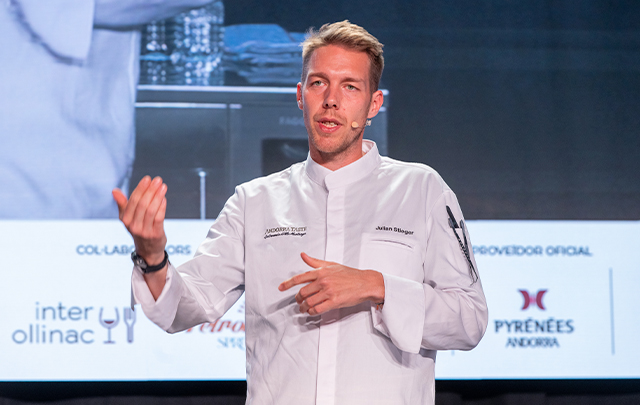
Some of the challenges posed by high-mountain cuisine took center stage during the second day of the fifth edition of Andorra Taste. Austrian chef Julian Stieger opened the discussion by speaking candidly about the challenges faced by chefs who are committed to regional cuisine in areas with many constraints. Stieger, chef at Rote Wand Chef’s Table** (Lech am Arlberg, Austria), reflected on the impact of seasonality in climates with harsh winters on the operations of a restaurant—one that, with two Michelin stars, must maintain high standards of quality. “Summer is the window of opportunity we have to stock up for the coming winter,” the chef explained, noting that “it’s a hectic time” because in Lech am Arlberg, July and August are the only months for harvesting and growing crops. This requires careful planning and the need to make the most of every ingredient.
In addition to the seasonal constraints in this region of the Austrian Alps—which are surely shared by many other mountainous areas—there is the physical limitation of scarce farmland. “The lack of land leads to a lack of product variety because we end up growing the same things over and over, and it gets boring,” acknowledged Julian Stieger. This is where a close partnership with producers becomes essential, the Austrian chef asserted. Although it was difficult at first to get the producers to listen to him, the chef at Rote Wand Chef’s Table managed to convince them to “do things differently than they had always been done, so that we could try new things.” Respecting tradition without falling into folklorism, while seeking new ways to highlight excellent products—as they’ve also done with cheeses—“with artisans who have understood that innovation isn’t at odds with respect for local produce.” This step has been essential to “beginning to build a community around Austrian Alpine cuisine.”
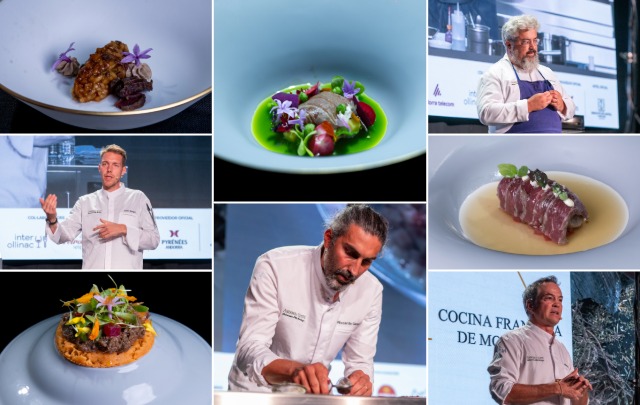
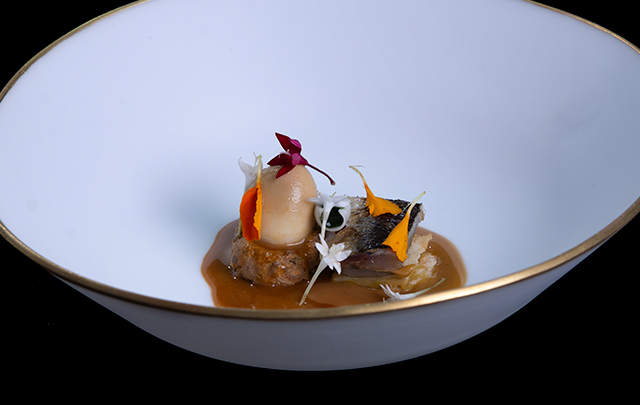
Another challenge is to respect the culinary heritage of these regions by adapting it to modern times without losing the region’s unique essence. Iván Cerdeño, chef at the two-Michelin-starred restaurant bearing his name in Toledo, addressed this dilemma by reimagining Ángel Muro’s “diabolical recipe” for red-legged partridge, featured in one of the most influential books in the history of Spanish cuisine, *El Practicón*. “The key is to approach it with respect,” acknowledged Cerdeño, who turned the recipe (partridge stuffed with sardines) on its head by creating sardines stuffed with partridge. “Reviving recipes from our gastronomic heritage is the best way to honor it,” declared the Toledo native.
This same respect for culinary heritage was mentioned by Vivien Durand, chef at Le Prince Noir* (Lormont, Bordeaux). This chef, originally from the Pyrenees, advocates “transforming classics into more playful dishes” and does so by acknowledging that “everything has already been invented, so returning to our roots is the way forward.” From that traditional mountain cuisine, the French chef takes away above all the lesson that “there are dishes that require time, and time is precisely what the mountains offer you.” An example of this was the foie gras with beets he prepared, in which the base is poached foie gras, not confit.
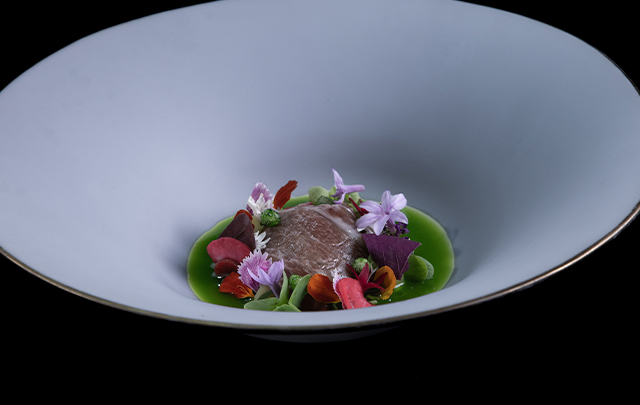
Clearly, traditional dishes are adapted to modern times not only out of creative curiosity but also because it’s important to take new needs into account. As Javier Torres, 50% of the creative duo behind Cocina Hermanos Torres*** (Barcelona), explained, high-mountain cuisine was traditionally a cuisine with a purpose—a cuisine of survival “featuring hearty, heavy dishes”—but today the ideal is to lighten those dishes. That is precisely what he has demonstrated with his unique adaptation of the popular trinxat, in which “without changing the traditional recipe or using different flavors, I sought to create a cleaner, more refined dish” featuring a trinxat made with cabbage juice, herbs, flowers, and a loin of Iberian pork cured in spiced salt.
A Round-Trip Journey
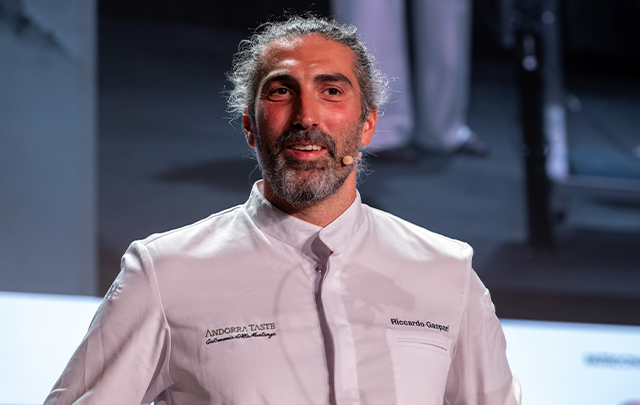
The fact that mountain cuisine draws from its surroundings and reflects its landscapes has been demonstrated in all the presentations at this edition of Andorra Taste, but Italian chef Riccardo Gaspari has introduced a new factor into this equation: “We must give back to the earth what we take from it.” Much of the culinary philosophy of SanBrite*, the restaurant Gaspari leads in the Italian Dolomites, is rooted in this virtuous cycle. The chef’s family owned a small farm, and Riccardo grew up getting up at dawn to feed the animals. This experience has allowed him to “appreciate all the work, time, and dedication that goes into every product.” Understanding the value of this is what led him to adopt regenerative cuisine at his restaurant, focusing on “avoiding waste by using the restaurant’s scraps to feed the animals and their manure to fertilize the vegetable garden.” Through this cycle, Gaspari forges a closer connection between the kitchen and the local region.
The revival of flavors and the relationship with local producers are the other pillars of his cuisine, an approach that follows the rhythm and colors of the seasons: “with fresh greens in summer and richer, more substantial flavors in winter that paint a palette of browns, grays, and white,” Gaspari described.
Manolo Franco, chef at La Casa de Manolo Franco* (Valdemorillo, Madrid), also demonstrated on this second day of Andorra Taste that “low-mountain areas, such as the Sierra de Madrid, share with mountain landscapes the same goal of a cuisine rich in flavor, history, emotion, and beauty.” At his restaurant, Franco develops a culinary narrative rooted in seasonality through which he aims to “cook the passage of time and demonstrate how the mountains change with each season.”
The day’s grand finale took the form of a roundtable discussion in which chefs Joël Sala (La Borda del Pi, Canillo), Rafel Muria (Quatre Molins*, Cornudella de Montsant, Tarragona), and Josep Maria Masó (Fonda Balmes, Barcelona) delved into the construction of culinary identity through the territory. Moderated by Benjamín Lana, director of Vocento Gastronomía, the discussion addressed the question of what a region’s identity truly is. “Cuisine cannot be merely a reflection of the environment and its traditions. There used to be lambs in Montsant, but now there are none left; frog legs were once cooked here, but they’re gone too; mussels from the Delta are only available one month a year. So, what is a place’s cuisine? Is it what we’ve been told existed, or what we’ve come to know as chefs? Or is it what will emerge when new ingredients arrive?” wondered Rafel Muria. These are questions with no easy answer—one that lies within each chef because, as Joel Sala said, “the territory sets no limits; you are the one who sets the limits.” Josep Maria Masó agreed with this analysis, noting that, in the end, “the authenticity of the concept and the commitment to it are the only things that sustain it.”
Related news
News
Andorra Taste breaks records with more than 70,000 drinks sold
News
Andorra Taste demonstrates that high-mountain cuisine can turn its limitations into a form of excellence
News
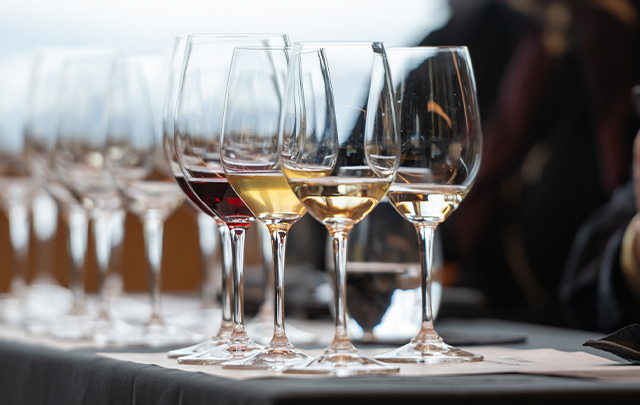
Exploring high-altitude wines: a presentation by Audrey Doré
News
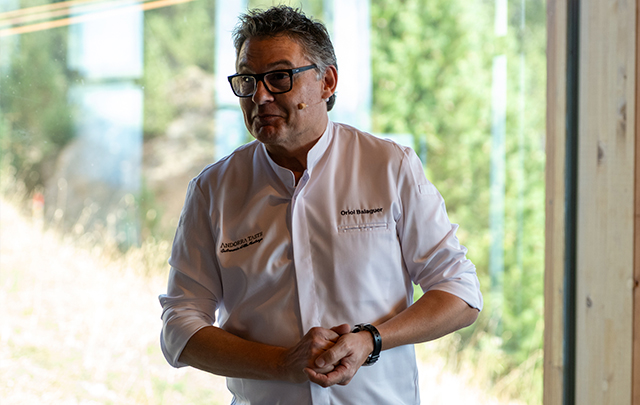
Innovation and trends in pastry: Oriol Balaguer's perspective
News
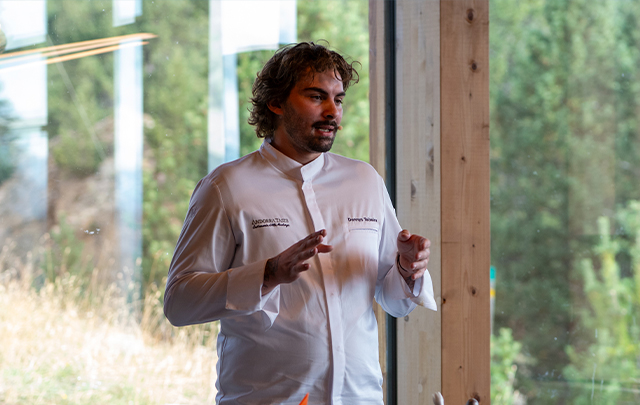
Gastronomy as narrative: innovation and collaboration in local cuisine
News
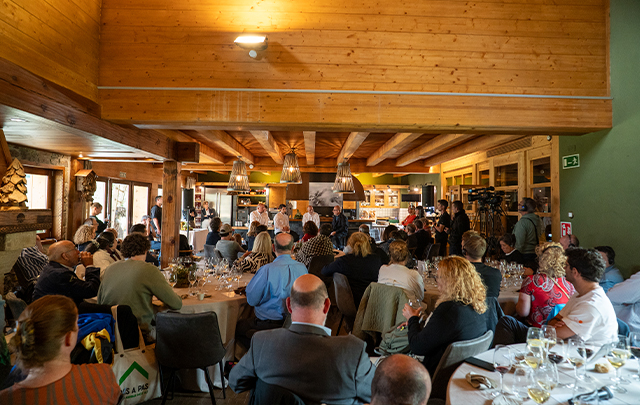
Traditional cuisine as a reflection of identity
News
Riccardo Gaspari's regenerative cuisine: a sustainable cycle from farm to table
News
Iván Cerdeño: hunting as a living memory of Toledo through the lens of haute cuisine
News
High-Mountain cuisine: Javier Torres and Andorra's culinary tradition
News