News
Andorra Taste demonstrates that high-mountain cuisine can turn its limitations into a form of excellence
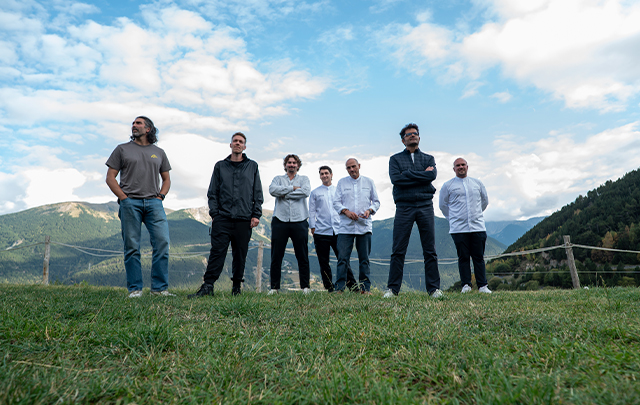
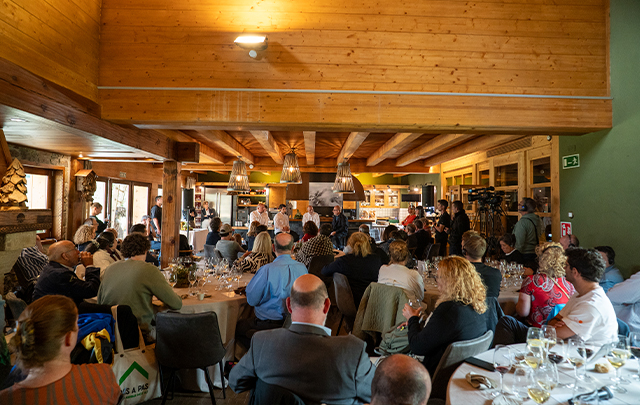
Andorra Taste, staying true to its philosophy of high-mountain cuisine, ascended to an altitude of 2,000 meters to host the final day of its professional conference. With magnificent views of the Massana Valley from the Coll de la Botella, speakers and attendees delved into the relationship between gastronomy, identity, and territory. The fifth edition of Andorra Taste has sparked interesting reflections on topics such as the limits of tradition—specifically, when a dish can be considered traditional—the interplay between tradition and modernity through the reinterpretation of mountain dishes to adapt them to current tastes and trends, and the necessary collaboration between producers and chefs to create unique products without losing their local essence.
Products were also a topic of discussion during the closing ceremony of this international event, where Benjamín Lana, director of Vocento Gastronomía, stated that this edition of Andorra Taste has demonstrated that “the knowledge of older generations regarding techniques and recipes—or that of the farmer who knows what the land needs—goes even beyond the product itself, because a product without knowledge is simply a raw material.” Indeed, as has been demonstrated over the past few days, it is important to know how to make the most of the mountain pantry, which can sometimes be limited or scarce, as the attending chefs rightly pointed out. Ultimately, knowing how to cook also means accepting what you don’t have.
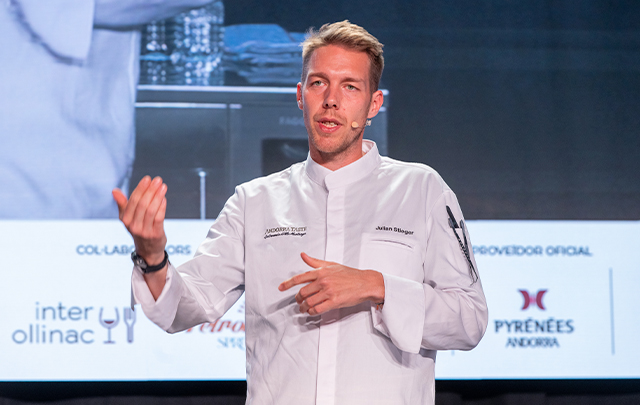
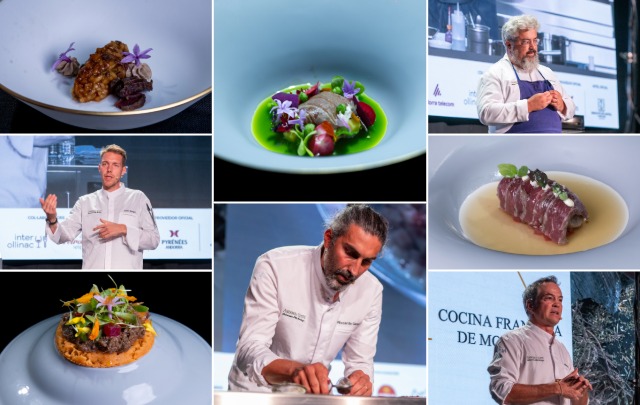
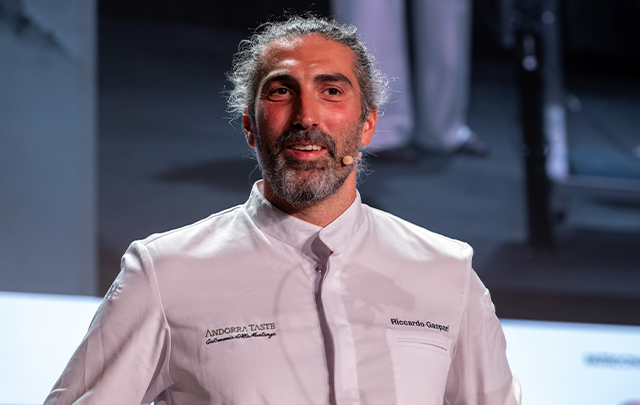
With the vision of chefs such as Emmanuel Renaut (Flocons de Sel***), Vivien Durand (Le Prince Noir*), Julian Stieger (Rote Wand Chef’s Table**), Iris Jordán (Ansils*), Iván Cerdeño (Iván Cerdeño**), Javier Torres (Cocina Hermanos Torres***) or the Italian Riccardo Gaspari (SanBrite*) and his regenerative cuisine, among others, Andorra Taste has outlined in its fifth edition a future for high-mountain cuisine in which a commitment to the region and the authenticity of the culinary offering are the keys to its success. The survival of this type of cuisine is essential because, as Betim Budzaku, CEO of Andorra Turisme, pointed out, “gastronomy is, without a doubt, a distinguishing feature.” A distinguishing feature, but not a divisive one. This was made clear by the chefs from the Alps, the Pyrenees, and the Andes, who, by sharing their experiences and knowledge, demonstrated “the universality of mountain culture.”
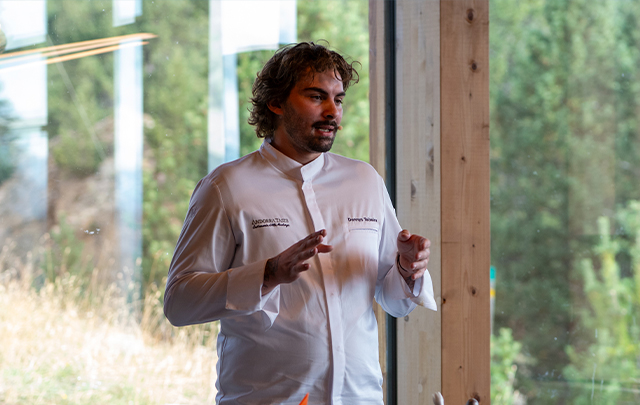
All these premises were confirmed by the speakers who took center stage during the morning session of Andorra Taste at Coll de la Botella. French chef Dennys Teixeira, who runs La Coopérative* at Domaine Riberach (Bélesta), explained that before embarking on this project, the first step was “to study and familiarize myself with the local products,” since these are the tools that allow a chef to interpret the region. Teixeira, who is of Spanish descent, also highlighted the importance of forging ties with producers because “by working together, we have a better chance of survival: not only for our culinary project but also for many local trades and activities that are in decline.”
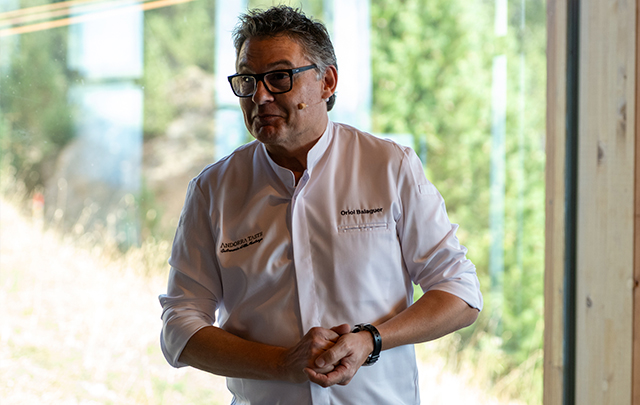
With Oriol Balaguer, a master chocolatier and pastry chef with shops in various locations (including Andorra), Andorra Taste has also explored the sweeter side of the mountains. The Catalan chocolatier illustrated how pastry-making also offers multiple possibilities for reflecting the local environment—not only through its ingredients (honey, fruits, etc.) but also because pastry creations serve as an intriguing creative vehicle for capturing the essence of the surroundings. As a trend—and in line with the desire shared by mountain chefs to adapt their offerings to current trends and tastes—Balaguer noted that modern pastry-making offers “healthy options that are also much more interesting from an organoleptic standpoint.”
When the Climate Forces Us Higher
“We’ll be hearing more and more about high-altitude wines,” said Audrey Doré, a French sommelier based in Girona who has been working side by side with the Roca brothers for years and serves as the director and head sommelier of the Roca family’s Vii project. Doré began her explanation of high-altitude wines this way during the tasting that traditionally closes the Andorra Taste professional conference.
During her presentation, Audrey Doré focused on the impact that climate change is having on vineyards at sea level or at low altitudes and advised mountainous countries to pay close attention because “this change presents them with a great opportunity.” With recurring droughts and high temperatures in the Mediterranean, the future of many of its vineyards is in question, and vineyards are being planted at increasingly higher elevations: “With so much heat, the vines ripen too quickly, and that’s not ideal because we either harvest too early or too late. At higher elevations, the daily temperature range is more pronounced, which helps better control the vines’ growth rhythm.”
At the tasting the French sommelier organized for Andorra Taste, several wines from wineries that have already recognized the need for change stood out—wineries that have launched high-altitude projects in areas such as Talarn (Lleida), the Sierra de Gredos, and Andorra itself, which has vineyards located above 1,000 meters.
Andorra Taste Public Event Opens
With the professional sessions of Andorra Taste now concluded, the public portion of this event—which has been very well received year after year—begins today. That is why, following in the footsteps of last year’s edition, which saw an increase in the initial number of participants, the 2026 edition is once again expanding its culinary offerings, with the number of tastings rising to 24. Located in Prat del Roure Park (Escaldes-Engordany), the fair will begin at noon on Friday, September 18, and will remain open until Sunday, September 20. Food lovers will have the opportunity to visit this open-air venue in the heart of Andorra during extended hours, from 12 p.m. to 11 p.m., except on Sunday, when Andorra Taste Popular will close at 8 p.m. Visitors will be able to enjoy a wide variety of Andorran cuisine, with chefs from local restaurants—as well as some bakeries—having prepared their tapas and small dishes especially for the occasion.
Related news
News
Andorra Taste breaks records with more than 70,000 drinks sold
News
Exploring high-altitude wines: a presentation by Audrey Doré
News
Innovation and trends in pastry: Oriol Balaguer's perspective
News
Gastronomy as narrative: innovation and collaboration in local cuisine
News
Mountain chefs need producers who are willing to challenge tradition
News
Traditional cuisine as a reflection of identity
News
Riccardo Gaspari's regenerative cuisine: a sustainable cycle from farm to table
News
Iván Cerdeño: hunting as a living memory of Toledo through the lens of haute cuisine
News
High-Mountain cuisine: Javier Torres and Andorra's culinary tradition
News