News
Andorra Taste proposes making the mountain’s lesson go viral: local produce as a source of inspiration and a driver of identity
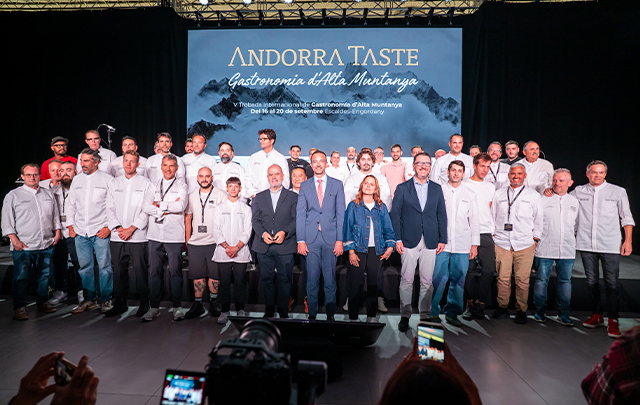
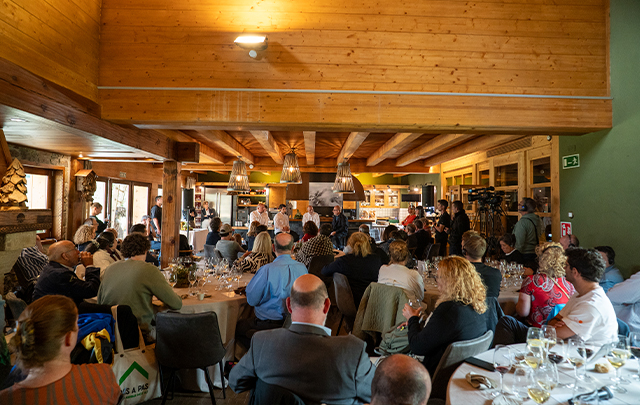
Andorra Taste opened the first day of its fifth edition by bringing some of the world’s leading figures in mountain cuisine to the stage of the Auditori Prat del Roure in Escaldes-Engordany. The aim was to showcase the richness of high-altitude produce and demonstrate how an evolution of mountain cuisine that respects tradition and the territory is essential to strengthening its identity and achieving sustainability. But not only that: it can also serve as a model that can be exported to other rural or urban ecosystems. Virgilio Martínez (Central, Lima), Emmanuel Renaut (Flocons de Sel***, Mégève), Iris and Bruno Jordán (Ansils*, Anciles), Paco Roncero (Paco Roncero**, Madrid) and Juanlu Fernández (Lú, Cocina y Alma**, Jerez) showed how research and innovation rooted in tradition can help enrich and preserve the essence of a place. Throughout the different presentations, it became clear how techniques that are increasingly relevant in contemporary cuisine —fermentation, ageing, fungal decomposition and others— can optimise the use of ingredients while capturing the aromatic and flavour nuances of both the products and the territory.
One of the highlights of the morning was the presentation by Emmanuel Renaut, one of France’s leading chefs, whose restaurant Flocons de Sel in Mégève, in the Savoy Alps, holds three Michelin stars. He has also been awarded the title of Meilleur Ouvrier de France. Renaut recalled that “for a long time, mountain cuisine was the great absentee in the mountains themselves. Restaurants did not offer it, and visitors did not appreciate it. Through our work over the past decades, mountain chefs have helped local producers continue practising their trades,” he said.
Renaut explained that “at an altitude of 1,200 metres, I have to create my cuisine every day while taking into account the ingredients available, the weather and the climate. Well, this should be common practice in every restaurant at these altitudes,” he argued. He added that “mountain cuisine is an actor that is destined to play an important role in the coming years because of its values.” In an edition of Andorra Taste centred on produce, the French chef highlighted the importance of producers. “The producers I work with are not my suppliers; they are my collaborators,” he stated.
Asked by a packed auditorium what the world of French cuisine can still learn, Renaut replied that “chefs, rather than teaching, share. In recent years, sharing has led us to learn from Spanish chefs, Nordic chefs and South American chefs, and those lessons have been useful to everyone. Twenty years ago, people ate the same things everywhere, whereas today we have become aware that cuisine also builds the identity of places,” he concluded.
Although the presentations were all of an exceptionally high level, the highlight of the first day came with the presentation of the 5th Andorra Taste Award to Peruvian chef Virgilio Martínez, a distinction previously awarded to figures such as Ferran Adrià, Carme Ruscalleda, Gastón Acurio and Michel Bras. Martínez also delivered a presentation in which he defended the universality of high-mountain territories. “Despite the hyper-local nature of products and techniques, I have found great similarities between the mountains of China, Japan and Russia and the mountains where we work,” he explained.
Virgilio Martínez presented the ecosystem of culinary, scientific, anthropological and cultural research and innovation of which Mater is the creative centre, and spoke about his latest project: the construction of a facility to preserve seeds at an altitude of 5,000 metres. “Innovation comes from ancestry,” he summed up.
During the award ceremony, Andorra Taste director Benjamín Lana described Martínez as “one of the chefs in the world who has most profoundly placed territory at the centre of creation and innovation”. Lana, who opened the congress alongside Andorran institutional representatives such as Jordi Torres Falcó, Minister of Tourism and Commerce, and Rosa Gili Casals, Mayor of Escaldes-Engordany, said he was particularly excited to launch the fifth edition because “Andorra Taste has demonstrated that cuisine does not only express the territory, but also helps to shape it.”
Another presentation that demonstrated just how much mountain cuisine has to teach us came from young siblings Iris and Bruno Jordán, from Ansils* restaurant in the Aragonese Pyrenees (Huesca). They represent the third generation of the family restaurant opened by their grandmother Pilarín in 1984. “Just like our grandmother, we try to welcome those who arrive and show them the essence of the territory through cuisine. That means a process of research that combines the knowledge provided by the community with the exploration of techniques such as fermentation or fungal transformation, which allow us to capture nuances of aromas and flavours from the collective memory that condense this territory,” explained Iris, who is responsible for the kitchen at Ansils.
“Just like my grandmother,” she added, “we also began cooking from tradition, and sometimes that can become a barrier when you feel the urge to evolve. We do not want to reinvent the territory, but to discover everything we still do not know about it —and that means researching and playing.”
Iris and Bruno’s search for flavours and aromas goes beyond individual ingredients and seeks to capture the territory as a whole. Trees, soil, water, smoke... For example, they transform the rancid fat traditionally used in their village’s potatoes with pork fat by metabolising it with a fungus, obtaining a kind of miso that combines the rancid note with a gentle umami character. They make dashi broths to capture the earthy aromas of potatoes. They also apply oxidative processes to extract acidity from apples, using that acidity to finish a mountain ceviche that is almost a complete expression of the territory: seasonal mushrooms confited in oil, freshwater crayfish, hazelnuts and pumpkin.
“We make an ‘amino’ sauce from freshwater crayfish to capture its nuances by fermenting it for six months. We make the tiger’s milk with a paste of sour apples. We finish the ceviche with leek ash to give it a smoky touch.” In short, the essence of a piece of land served in a ceviche.
Iris Jordán explained that producers and the ethical commitment to avoiding waste also act as stimuli and a driving force behind their creativity. “We have a lamb dish that was born from conversations with local residents. For example, a young couple of butchers who had moved to the village to support the shepherds asked us for help because they only sold shoulders and racks, while their cold rooms were full of everything else. We asked them to send us the cuts they could not sell. We then visited some neighbours who run a cheese dairy and could not make use of their whey. We decided to combine the whey with the lamb. After ageing the meat for three days, we vacuum-pack it with the whey and cook it at a low temperature.”
“We also make a lamb toffee by reducing the whey and lamb trimmings over the heat. In the end, we have developed our own flavour enhancers that capture the aromas of the mountains, and by using them we have also reduced our use of salt and sugar in the kitchen to almost zero,” she added.
Paco Roncero compared his work of capturing the essence of Madrid to climbing a mountain, because “Madrid resembles a constantly growing mountain that, through accumulation, could turn into a volcano. In that context, the projects that will survive are those capable of maintaining their identity. The challenge is no longer to open, but to endure,” he explained.
Roncero found the essence of Madrid’s identity in the tapa, the central theme of his menu Madrid, Madrid, Madrid. Through the use of misos, fermentation, digital printing and laser-cutting techniques, among others, Roncero captures the essence of Madrid’s tapas and translates them into a menu of around twenty refined, contemporary bites with familiar and evocative flavours: gambas al ajillo, a calamari sandwich, the classic pairing of anchovy and boquerón...
Chef Juanlu Fernández of Lú, Cocina y Alma** in Jerez, connecting with the spirit of resourcefulness and research rooted in the traditions of mountain cuisine, defended the use of humble ingredients, “which, when properly treated, can surpass many of those considered great products.” His presentation focused on making the most of fish such as borriquete, drawing on the knowledge passed down by older generations. “Older people pass on knowledge that, when you put it into practice, can make an enormous difference. They may not know the scientific explanation, but they know from experience,” he explained.
Fernández brought to the Andorra Taste stage a technique for indirectly ageing fish with aromas of salt and amontillado wine, in which the fish does not come into direct contact with either the salt or the wine.
Related news
News
Andorra Taste breaks records with more than 70,000 drinks sold
News
Andorra Taste demonstrates that high-mountain cuisine can turn its limitations into a form of excellence
News
Exploring high-altitude wines: a presentation by Audrey Doré
News
Innovation and trends in pastry: Oriol Balaguer's perspective
News
Gastronomy as narrative: innovation and collaboration in local cuisine
News
Mountain chefs need producers who are willing to challenge tradition
News
Traditional cuisine as a reflection of identity
News
Riccardo Gaspari's regenerative cuisine: a sustainable cycle from farm to table
News
Iván Cerdeño: hunting as a living memory of Toledo through the lens of haute cuisine
News